 SlimFaas
Durable Streams
Streams are bounded, ordered event logs replicated by SlimData/Raft. Unlike Events, they retain publications for sleeping functions. Unlike an async queue, each subscribed function consumes independently. Replicas of one function share its consumption state; one replica receives each attempt.
Try the Guided Tour's two-consumer demonstration in native local mode, a precompiled bundle, Compose or Kubernetes. It waits for both subscriptions, checks both independent ACK positions and reads the exact retained publication afterwards. The standard tour also demonstrates DLQ repair. It also includes an independent persistent WebSocket job that processes synchronous, asynchronous, event and Stream messages through one outbound connection. Publication can arrive on any node; WebSocket consumption remains owner-local with shared Raft reservations.
Architecture
Each subscribed function has independent durable progress; replicas of that function share its consumption state. An unavailable or slow consumer does not hold the publisher's connection or prevent another function from progressing. HTTP dispatch is leader-owned; WebSocket-owning nodes reserve from the same replicated state. Completion order may differ from append order.
Visibility and dashboard defaults
Streams follow the same independent dashboard/management configuration as DLQs:
{
  "SlimFaas": {
    "EnableFront": true,
    "Streams": {
      "DefaultVisibility": "Private",
      "EnableFront": false
    }
  }
}
SlimFaas:Streams:DefaultVisibility controls management and observation access,
including catalog, history/bodies, subscriptions, reservations, ACKs and deletion.
The production default is Private: only trusted internal callers can manage
Streams, even if the Stream itself is Public. Public management still respects
individual Private Stream/function visibility. This setting does not change
Data's default visibility for publisher-created Streams.
SlimFaas:Streams:EnableFront also requires global SlimFaas:EnableFront. When
off, Stream navigation, actors, subscriber details and Stream activity are hidden;
a direct #/streams URL explains that the UI is disabled. An enabled UI with
insufficient permission instead shows a restricted-caller notice. SSE exposes
StreamsFrontEnabled and StreamsAccessible, retaining StreamsAvailable.
Disabled/restricted observation does not read Stream state.
Neither setting disables HTTP/WebSocket delivery or publishing through
/publish-stream/... and POST /data/streams/{stream}. Those retain their entity
access rules. Authorized REST management also remains usable with the UI off.
The existing native, Compose and Kubernetes demos explicitly use Public management
and enable the Stream UI. In native local mode, explicit
SlimFaas__Streams__DefaultVisibility / SlimFaas__Streams__EnableFront
environment values override these development defaults.
Dashboard gallery
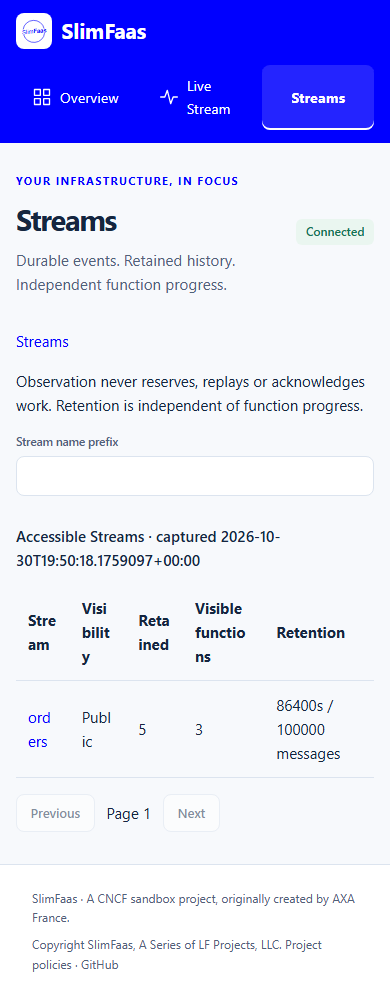
The dashboard's Streams page includes a retained Stream catalog, per-Stream history, independent function progress and message details. Body previews are bounded and render untrusted payloads as inert text.
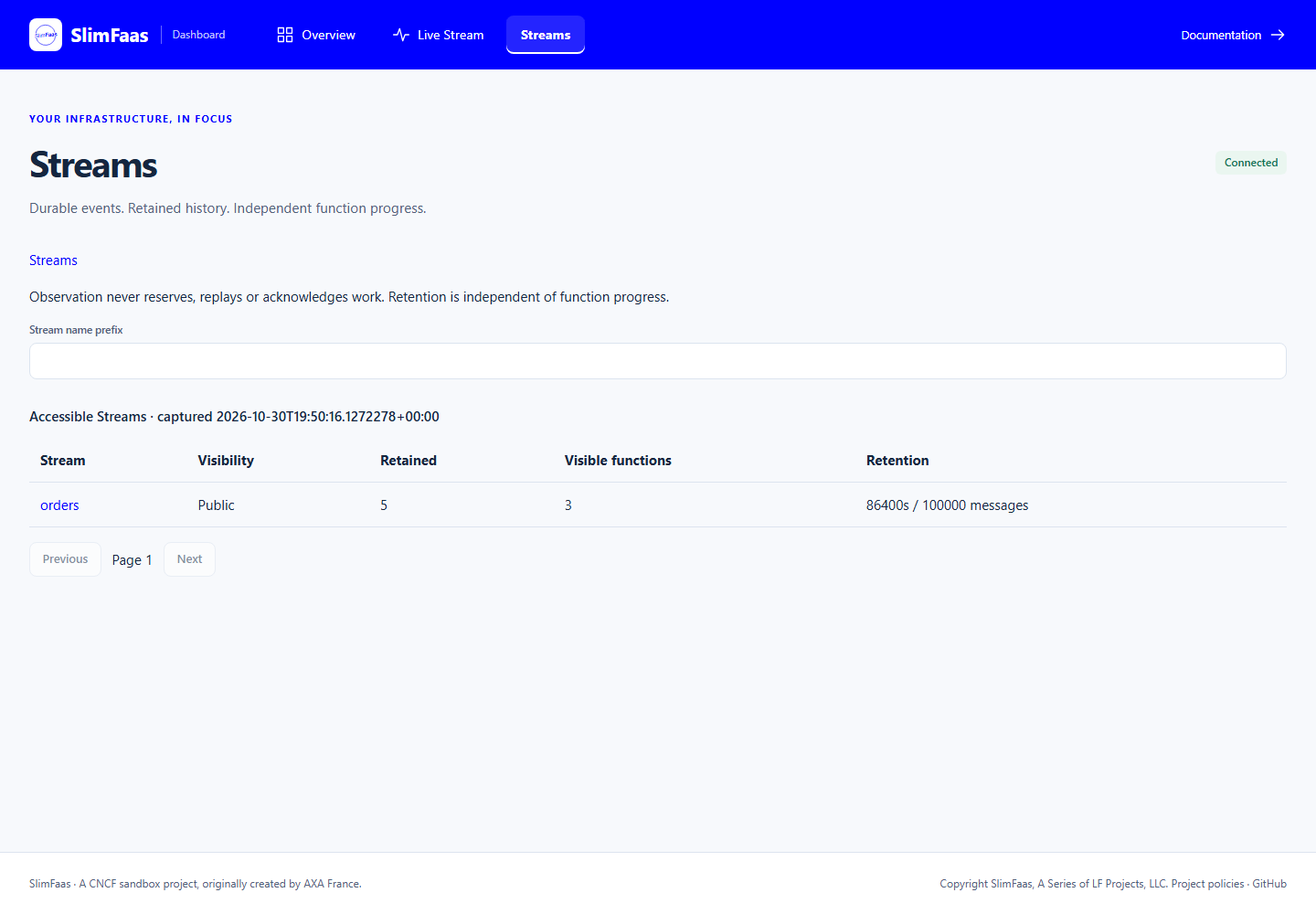
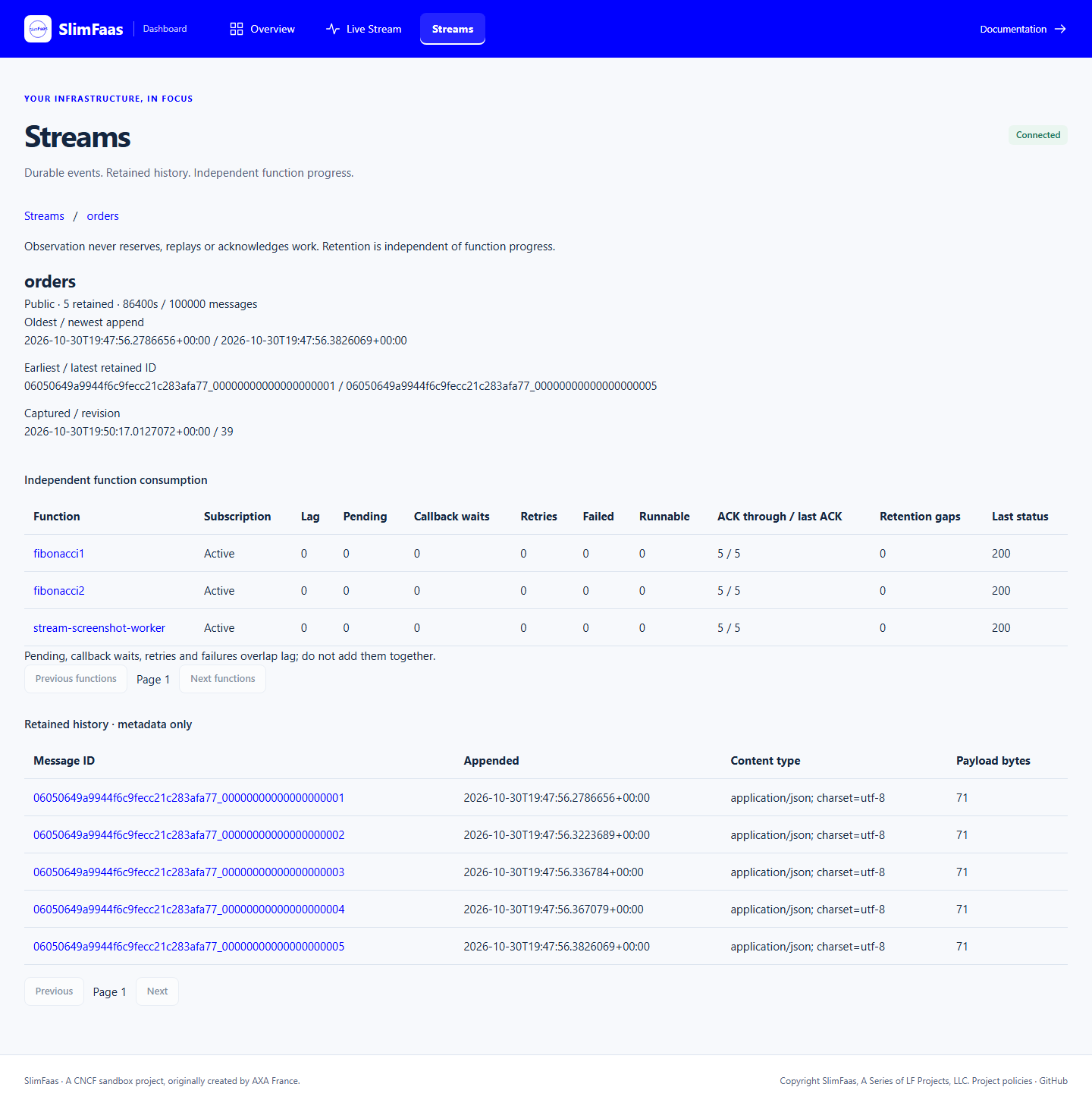
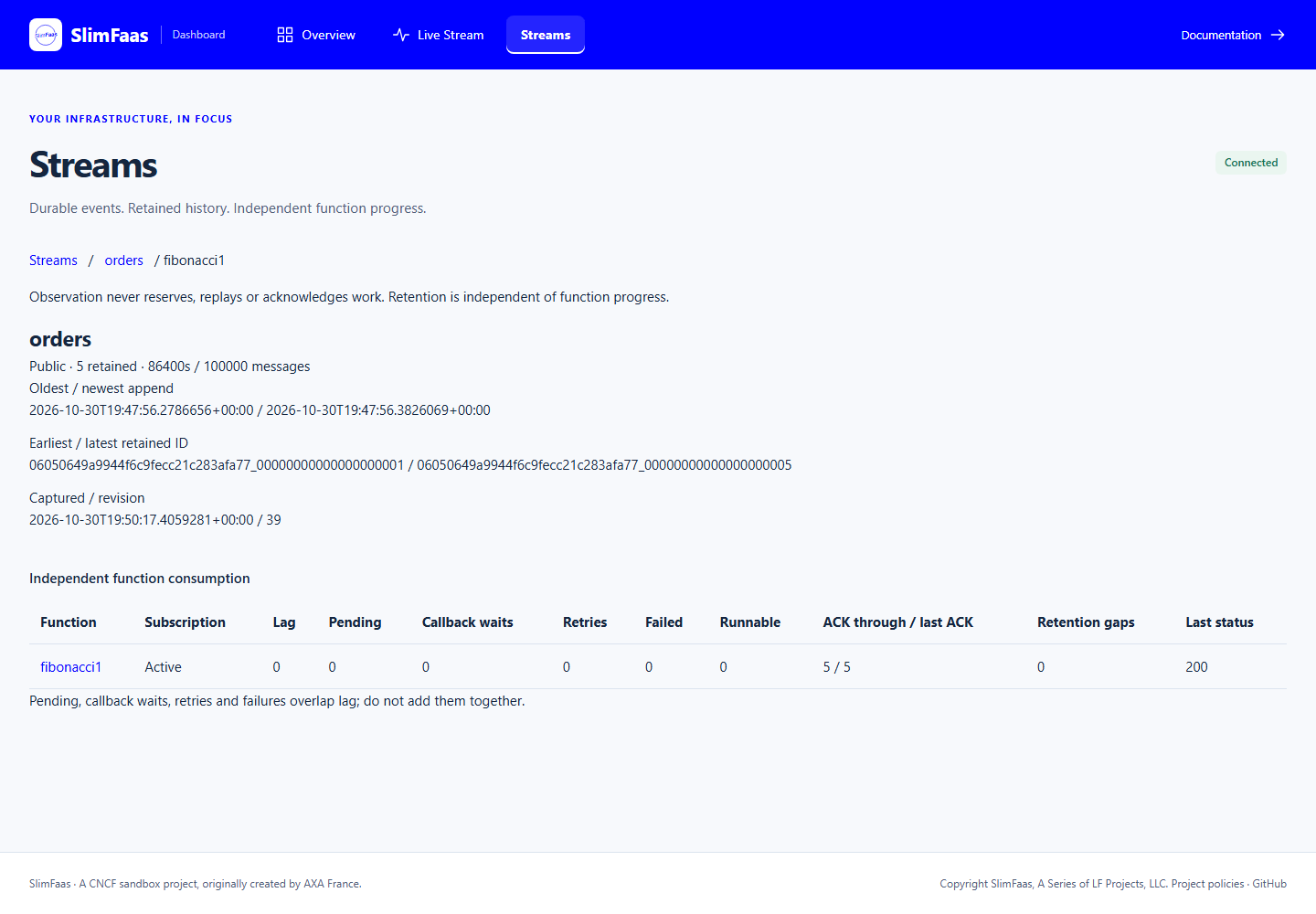
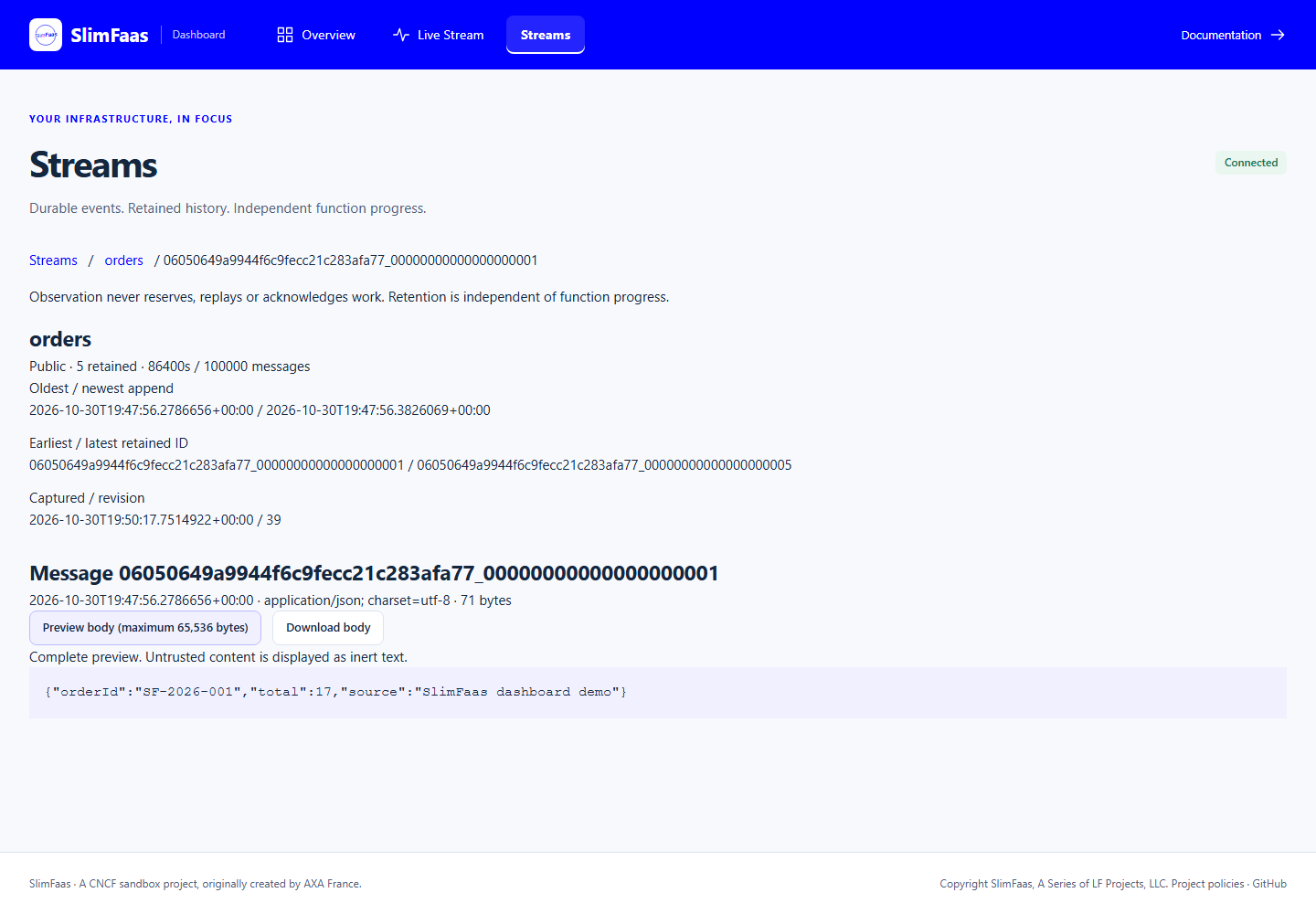
The catalog also adapts to narrow screens:
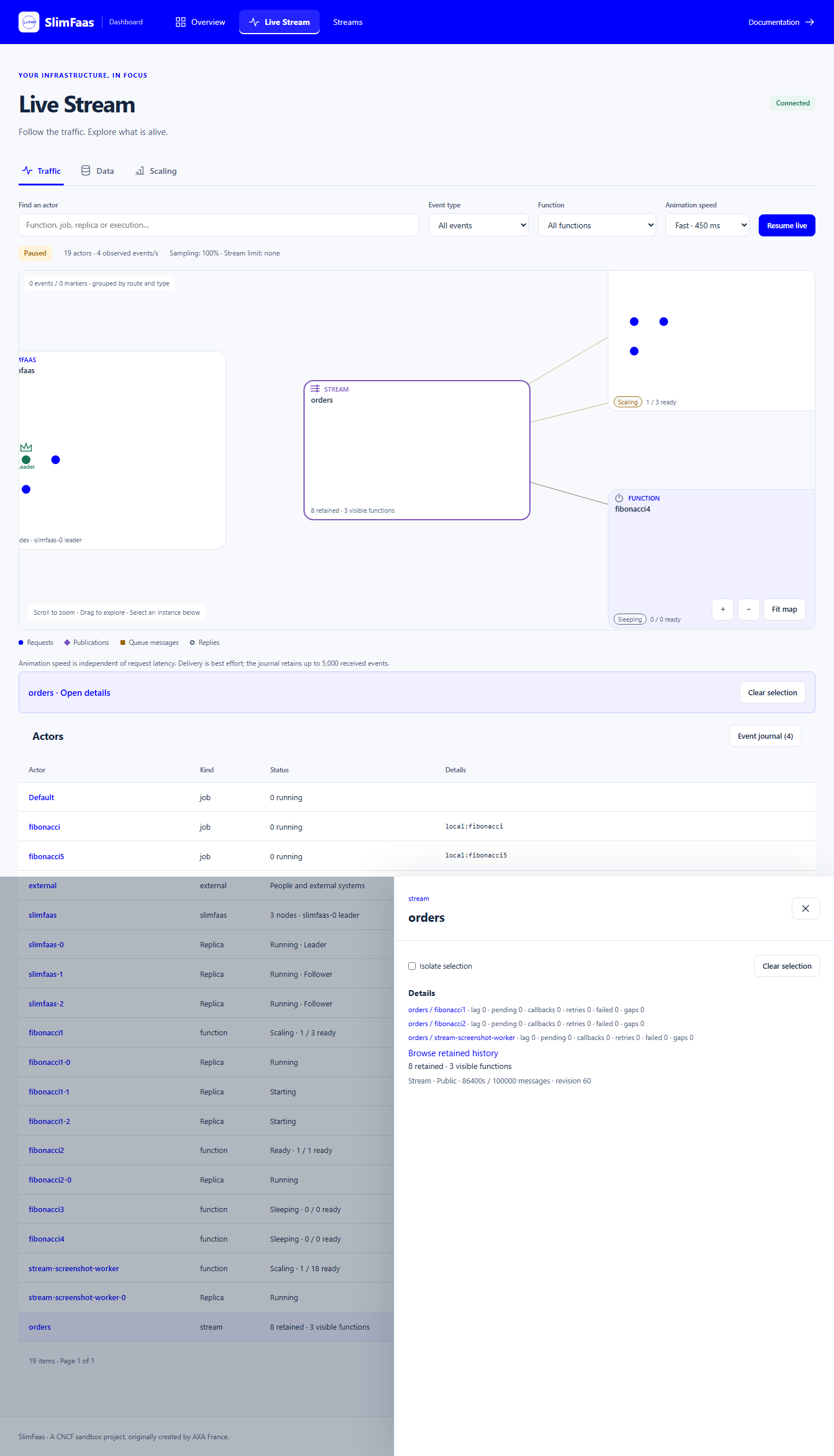
Live Traffic represents a Stream as a distinct actor. Its details link to retained history and list subscriber progress; the event journal includes Stream lifecycle and delivery events.
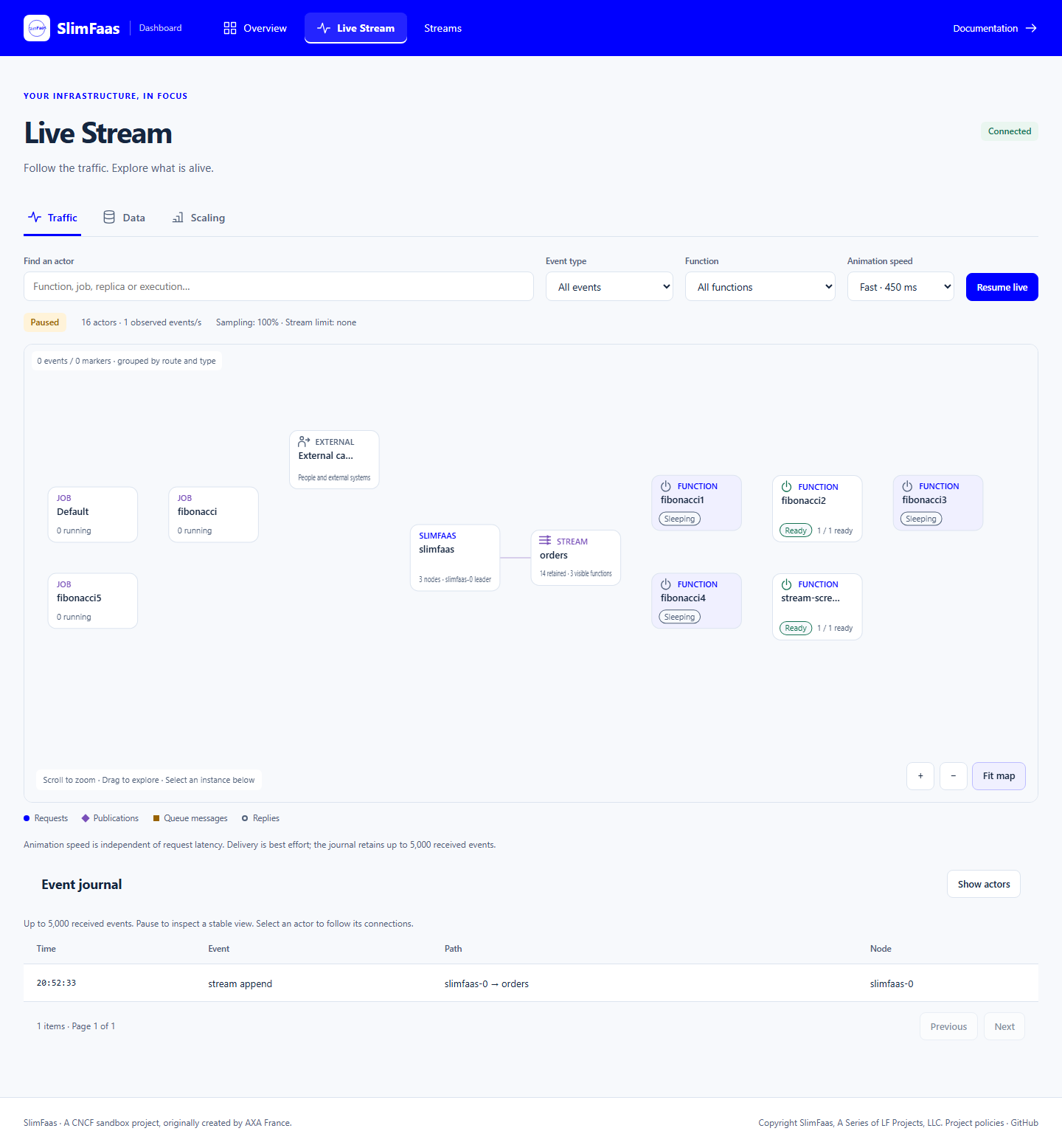
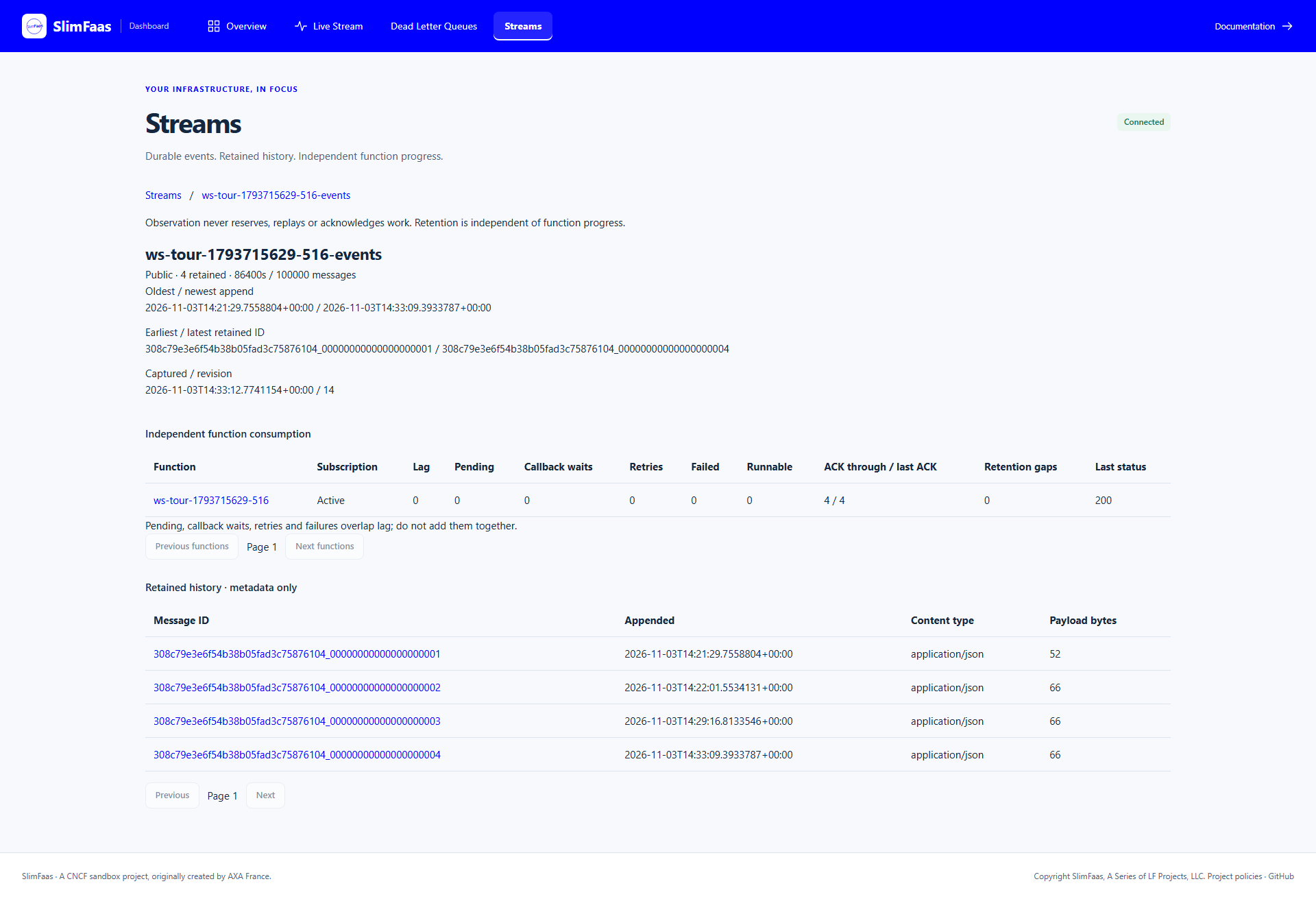
The independent WebSocket job exercise also demonstrates Stream delivery through the official SDK while the worker remains running. Its dedicated history shows retained messages and that virtual function's acknowledged progress. Accepted ACK/callback-wait events remain accurate when the receiving node's local replicated snapshot is briefly behind; they do not display a successful completion as a Stream failure. The live map pairs delivery and ACK by the Stream attempt identity, rather than treating it as a missing HTTP event; isolated Stream actors show both moving legs.
Configure a function
metadata:
  name: billing
  annotations:
    SlimFaas/SubscribeStream: "Private:orders,Public:notifications"
    SlimFaas/StreamMaxAge: "24h"
    SlimFaas/StreamMaxLength: "100000"
    SlimFaas/NumberParallelRequest: "10"
    SlimFaas/NumberParallelRequestPerPod: "5"
Unprefixed subscriptions inherit SlimFaas/DefaultVisibility. Retention defaults
to 24 hours and 100,000 messages. Age accepts positive integer seconds or an
integer followed by s, m, h or d. Names contain ASCII letters, digits,
hyphens, underscores or dots, up to 256 characters; . and .. are invalid.
All declarations of a Stream must agree on visibility and retention. A conflict
is rejected, preserving the committed policy. To replace a policy, drain active
deliveries, delete the Stream and recreate it; this creates a new generation.
New subscriptions start at the committed tail, receiving only subsequent appends. Explicitly removing and re-adding a subscription starts a new generation at the then-current tail. A WebSocket disconnection is not an unsubscribe: reconnecting with the same function and configuration resumes its durable progress. All clients sharing a function name must use the same complete registration configuration, including dependencies, retry policy and visibility. Conflicting retained registrations fail even when the previous client is offline; disconnect all clients and explicitly unsubscribe from every Stream before replacing that configuration.
Publish and deliver
curl -i -X POST http://localhost:5000/publish-stream/orders/compute \
  -H 'Content-Type: application/json' --data '{"orderId":"42"}'
Like publish/subscribe, the publisher chooses the application path. This example
delivers POST /compute with the original query, headers and body. Root append
POST /data/streams/orders delivers POST /. The 202 append receipt contains
Stream and MessageId, and a Location header; it confirms durable acceptance,
not function processing. Unknown Streams are created using Data's default
visibility and the default retention, subject to caller access.
HTTP/1.1 202 Accepted
Location: /data/streams/orders/messages/<messageId>
Content-Type: application/json

{"Stream":"orders","MessageId":"<messageId>"}
All three publication forms (/publish-stream/{stream},
/publish-stream/{stream}/{path}, and /data/streams/{stream}) now return
202 instead of 201. Update clients that assert the exact old status; the
receipt fields, ID format and Location are unchanged. The request still waits
for body ingestion, validation and durable commit, never recipient receipt,
readiness, processing or acknowledgement. Persistence failures do not produce
an accepted receipt. This publisher response is distinct from a recipient
returning 202 to request deferred completion.
The request body limit is 14 MiB. Prefer small messages referencing Data Files; reading a Stream never downloads referenced files, extends their TTL or changes their access policy.
HTTP deliveries carry SlimFaas-Stream-Name, SlimFaas-Stream-Message-Id,
SlimFaas-Element-Id, SlimFaas-Try-Number and Slimfaas-Last-Try.
Final 2xx excluding 202 acknowledges that function's attempt. 202 keeps
capacity reserved while waiting for the existing callback:
POST /async-function-callback/billing/<SlimFaas-Element-Id>/success
POST /async-function-callback/billing/<SlimFaas-Element-Id>/error
Timeouts and retryable statuses use Configuration.DefaultAsync's timeout and
retry policy. Attempts have persisted leases; stale attempt callbacks cannot
acknowledge a later attempt. Delivery is at least once: make handlers
idempotent using the Stream message ID. Concurrent completion can be out of
append order. Exhausted/non-retryable failures remain unacknowledged, stop
retrying, and do not block later messages or create endless scaling demand.
They are not automatically copied into async-function dead-letter queues.
WebSocket functions
Both official clients expose a dedicated Stream handler. Numeric
frame types and sync streaming are unchanged. Registration adds subscribeStreams,
streamMaxAgeSeconds and streamMaxLength. Servers advertise streams-v1;
clients requesting Streams reject servers that do not advertise this capability.
Delivery reuses AsyncRequest with additive streamName and messageId.
var config = new SlimFaasClient.SlimFaasClientConfig {
    FunctionName = "billing-ws",
    SubscribeStreams = [new() { Name = "orders", Visibility = SlimFaasClient.FunctionVisibility.Public }]
};
await using var client = new SlimFaasClient.SlimFaasClient(new Uri("ws://localhost:5000/ws"), config);
client.OnStreamMessage = message => Task.FromResult(200);
await client.RunForeverAsync(CancellationToken.None);
import asyncio
from slimfaas_client import SlimFaasClient, SlimFaasClientConfig, SubscribeStreamConfig, FunctionVisibility

async def main():
    config = SlimFaasClientConfig(
        function_name="billing-ws",
        subscribe_streams=[SubscribeStreamConfig("orders", FunctionVisibility.PUBLIC)])
    async with SlimFaasClient("ws://localhost:5000/ws", config) as client:
        async def handle(message):
            print(message.stream_name, message.message_id, message.element_id)
            return 200
        client.on_stream_message(handle)
        await client.run_forever()

asyncio.run(main())
Returning 202 from a Stream handler sends an intermediate callback and retains
the attempt until SendCallbackAsync(elementId, status) / send_callback(...).
Returning an error or throwing does not acknowledge the message. Ordinary async
handler behavior is unchanged. External WebSocket processes are not launched or
scaled by SlimFaas; their backlog and shared capacity remain observable.
Observe without consuming
All GETs below are passive and never reserve work, acknowledge messages or wake
functions. Pages contain Items, NextCursor, CapturedAt and Revision.
Default page size is 100; maximum is 500.
Catalog and function pages select accessible definitions/subscriptions before calculating metadata and counters. A page's lookahead row preserves next-page detection; catalog revision still includes that row. Single Stream metadata and single-function reads project only the requested resource from the read snapshot.
| Route (GET) | Result |
|---|---|
/data/streams?prefix=ord&after=<cursor>&limit=100 |
Accessible catalog |
/data/streams/orders/metadata |
Retention, boundaries and visible function count |
/data/streams/orders?after=<messageId>&limit=100 |
Retained message metadata |
/data/streams/orders/messages |
Same history |
/data/streams/orders/messages/<id> |
One message's metadata |
/data/streams/orders/messages/<id>/body |
Explicit inert attachment; supports byte ranges |
/data/streams/orders/functions?after=<cursor> |
Independent function summaries |
/data/streams/orders/functions/billing |
One subscription |
Use the returned cursor only with the same resource and filters. History outside
the retained generation/boundary returns 410, including EarliestMessageId.
No bodies, credentials or application headers appear in metadata lists.
Advanced consumption APIs are POST .../functions/{function}, POST .../functions/{function}/read (reserve) and POST .../functions/{function}/ack/{messageId}. ACK requires the reservation's
SlimFaas-Element-Id header. Normal HTTP/WebSocket handlers do not call these.
DELETE .../functions/{function} explicitly unsubscribes, including an offline
WebSocket function. In-flight callbacks may finish; re-subscribing returns 409
until they finish or expire. Remove HTTP subscription annotations first to
prevent a new leader from reconciling the subscription back into place.
DELETE /data/streams/orders returns 409 while a delivery or callback wait is
active; otherwise it deletes retained data and subscriptions.
Counters and scaling
RetainedMessageCount counts stored messages, regardless of ACKs. Lag counts
retained, unacknowledged messages within the subscription's range. PendingCount
is the already-delivered subset of lag; callback waits, scheduled retries and
terminal failures overlap pending. Do not add overlapping counters together.
RunnableCount is lag excluding terminal failures, including active/callback
work only once. It feeds native scaling without an exporter, respects dependency
readiness, existing scaling policies and replica bounds, and permits idle
scale-to-zero. AcknowledgedThrough is contiguous successful progress;
LastAcknowledged alone does not prove earlier success. RetentionGapCount
reports lost unacknowledged messages, never successful ACKs.
Visibility and dashboards
Private Streams require existing internal/trusted-workload access on every route, including callbacks. A public function does not expose a private Stream. Public Streams do not expose private function names/counts. Catalogs and SSE state/activity are filtered per caller, independently of Data metadata exposure.
With SlimFaas:EnableFront, open #/streams for the catalog, Stream history,
function summaries and message detail. Bodies load only on explicit preview
(maximum 65,536 bytes, inert text) or download. The page uses the shared status
SSE with activity=false; it does not subscribe separately or reserve work.
Traffic displays distinct Stream actors and actual selected replica deliveries;
ACKs never animate removal. Live snapshots are bounded to 500 Streams and 500
subscriptions, with an explicit truncation flag; use paginated APIs for more.
Native demo
dotnet run --project src/SlimFaas -- local up -f ../../slimfaas.local.yaml
curl -X POST http://127.0.0.1:30020/publish-stream/orders/compute \
  -H 'Content-Type: application/json' --data '{"iterations":1}'
curl http://127.0.0.1:30020/data/streams/orders/functions
The base demo subscribes two functions independently. The base Kubernetes and Compose demo configurations include the same subscriptions; see Stream examples.